
The Issue: In most states, anyone can call themselves a mold inspector or remediator.
The mold inspection and remediation industry is largely unregulated, and most states have no required training or standards. As a result, many practices that pass as “inspection” or “remediation” are insufficient or even unsafe. Inspections that rely only on testing can miss problems. Remediation that attempts to “kills” or paint over microbial growth does not remove the health risk. Instead, microbial growth should be safely removed, and the moisture problem that caused it fixed.
These five steps show you what a thorough, safe process looks like.
Steps for Inspecting & Remediating Your Home For Mold & Water Damage
The 5 Steps
1
Inspect
Inspect your home or building for signs of microbial growth and water damage. If found or suspected, hire a knowledgeable Indoor Environmental Professional (IEP) who can determine the extent of any problems and determine next steps
2
Remediate
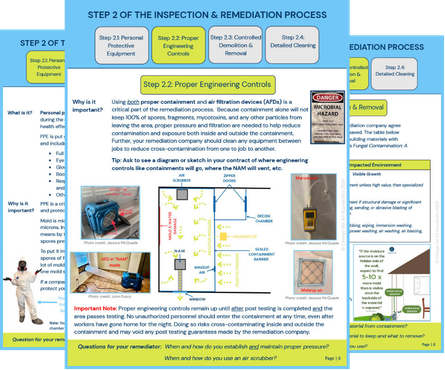
If remediation is recommended, hire a knowledgeable remediation company that follows, at a minimum, the ANSI/IICRC S520 Standard for Professional Mold Remediation.
3
Verify
Perform post-remediation verification (clearance testing). This is typically done by a third party such as an IEP.
4
Clean
Clean the rest of the home and belongings (sometimes known as small particle cleaning), and consider cleaning the HVAC and ductwork (if HVAC and ductwork were not addressed as part of Step 2) to remove cross-contamination. Additional testing may be considered at this point.
5
Reevaluate
Reevaluate how you feel in the home and consider working with a knowledgeable healthcare practitioner if health symptoms and concerns persist. Implement preventive measures, regular maintenance, and a cleaning schedule.
Prefer to watch?
Get our free guide,
Mold Remediation at a Glance.
Copyright 2026 Change the Air Foundation , a 501(c)(3) nonprofit organization, EIN 88-0804383